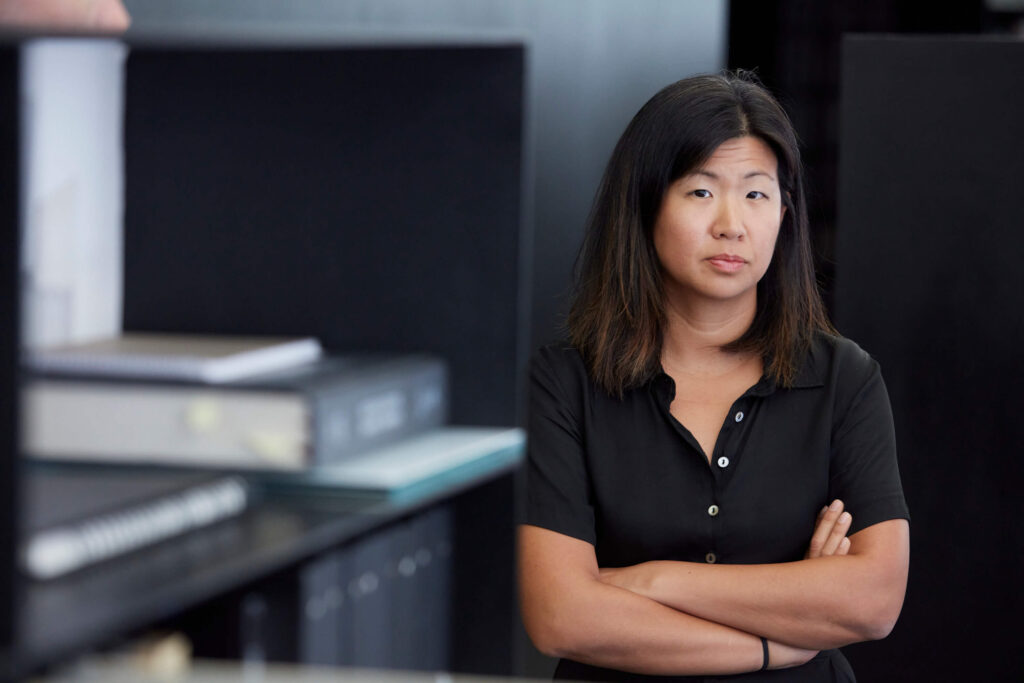
For last year’s first and second posts of our Spotlight series, I talked with two members of the MR team who have been with the firm for over twenty years. You might say it’s a trend here for people to stay a while, as for our third post of the series, I interviewed architecture associate Karina Kou whose tenure is approaching 18 years. In her time with MR, she has worked on a wide range of projects of all types—from retail stores including Trina Turk and Jay Godfrey to development projects such as 21W20th to residential projects both in the city and in the Hamptons. While we see Karina on a daily basis, I imagine few of us know what it was that led her to study architecture, what motivates her and how she thinks about the profession. Here’s what she shared with me.
When did you know you wanted to be an architect?
My father was an engineer, and my mom studied interior design, so I think I inherited an interest in both fields. I was always fascinated by the new houses being built in my neighborhood and would watch them go up. I even remember sneaking onto a construction site once or twice with a friend to tour houses while they were being built. I was also determined to go to the University of Michigan, and they happen to have an excellent architecture program, so it made sense to pursue architecture there. I did a couple internships at an architecture office during high school and college and enjoyed the experience, so I kept going down that path.
And how did you arrive at MR? What were you up to before that?
I grew up in the suburbs of Detroit, Michigan. After graduating from the University of Michigan with a BS in Architecture, I moved to New York and worked for a few years at a firm that does healthcare interiors and affordable housing projects. I then returned to the University of Michigan to pursue my Master’s degree in Architecture and studied abroad in Italy for a semester. After graduating, I moved back to New York and worked at Workshop/APD for a few years on beach houses in Nantucket and apartment renovations in NYC. I joined MR in 2008 through a mutual connection and have been here ever since.
Oh wow! Where in Italy? What did you gain from that experience?
I studied in a small town called Sesto Fiorentino about 30 minutes outside of Florence. This was the first time I had ever been to Europe and living there brought me out of my comfort zone, challenging my perspective on the world and giving me a deeper understanding of Italian culture. There was a small coffee shop close to the School Villa that I went to everyday, where I would interact with local people and attempt to speak Italian.
Was there any specific architecture there that really impacted you?
I studied Renaissance architecture while I was there and had the opportunity to examine how the buildings that were surrounding me had evolved from the 15th to 16th centuries. We closely observed buildings and analyzed subtle architectural details, learning to identify the nuances that distinguished different periods while developing an appreciation for symmetry and balance. One of my favorites was courtyard at Palazzo Strozzi.
I know you got licensed while working here at MR. What was that process like?
It’s definitely a commitment, but worth doing. At the time, there were seven exams which you had to pass within five years of taking the first one. It was a challenge to find time at night and on weekends to study in between working on projects. I used to spend my Saturdays and Sundays in the dining area of the Whole Foods by my apartment and I would review piles of flash cards while riding the subway. But I made it through!
So is architecture, as a profession, what you thought it would be? How is it different?
In many ways it is what I expected, but the process is more complex than I realized as a student. The profession requires a wide range of skills from creativity and design thinking to knowledge of construction, materials, and the basics of structural and mechanical systems.
And what do you consider to be the best part of it? The most challenging?
The best part of being an architect is the ability to conceptualize a built environment out of thin air and then see it come to life. Turning an idea into a physical space that people can experience is incredibly rewarding. One challenge in architecture is encountering unexpected conditions after demolition. Hidden pipes, structural elements, asbestos, or damage may be revealed once walls and ceilings are opened, requiring revisions to the design.
How would you describe your design philosophy or style in a few words?
Thoughtful, balanced, practical, and detail-driven.
Can you give me an example?
An example would be designing a door. While it may seem simple and/or unimportant, there are so many things to think about from scale and proportion to selecting the right hardware to make it function the way you want it to. And then zooming in on the details of the door, whether it is intended to make a statement or be completely invisible.
What is your favorite part of a project?
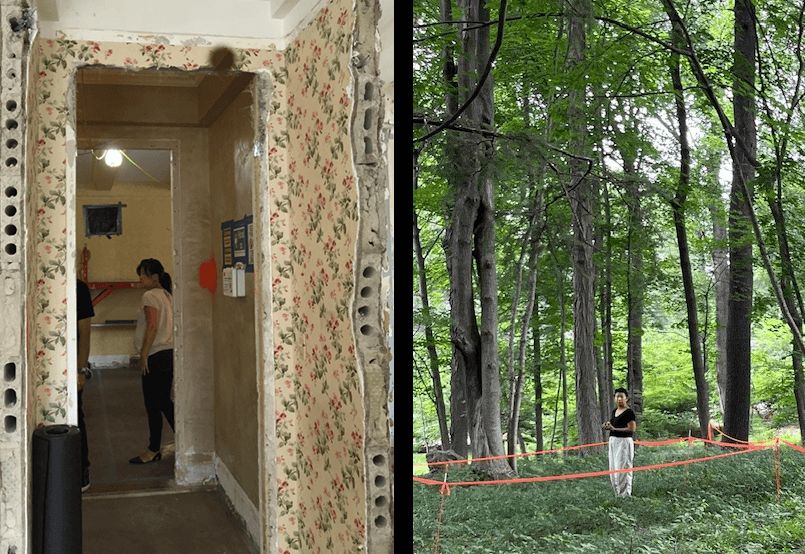
My favorite part is toward the end of the construction, when months of planning and design finally come to life and you can see the ideas take physical form. But I also really like seeing a building right after demolition. There are often surprises hidden behind the walls—sometimes a note or sketch left by a previous contractor or owner, or vintage wallpaper, tile, or patterned flooring that gives a glimpse into the building’s history.
Any good on-the-job stories?
At one of our projects outside of the city, the scope included a garden folly. Our client wanted it hidden in the trees, but the location had to make sense in relation to the existing landscape, and it had to allow for a view to the main house. At one site visit, I spent part of the afternoon staking out the property for a place that would work, and at one point, found myself in a field of poison ivy. Thankfully I managed to emerge unscathed.
Where do you turn for inspiration?
My friends in architecture and colleagues are a big source of inspiration. Seeing what others in the field are doing and discussing ideas together is always motivating.
What part of the profession do you really enjoy digging into?
I enjoy digging into problems that feel like a puzzle—whether it’s fitting a program into a limited space, working through zoning or code restrictions, or finding the right hardware solution to make something function in a specific way.
What advice would you give to someone starting out in architecture or interior design?
Take a deep dive into every task, even if it seems small or inconsequential. There’s always something you can learn from it that can be applied to bigger parts of a project later on. Paying attention to the details early on helps build a stronger understanding of the overall process.
What are you most proud of career-wise so far?
I’m proud of all the projects I’ve worked on. Whether large or small, each one requires a lot of thought and consideration and comes with its own unique challenges.
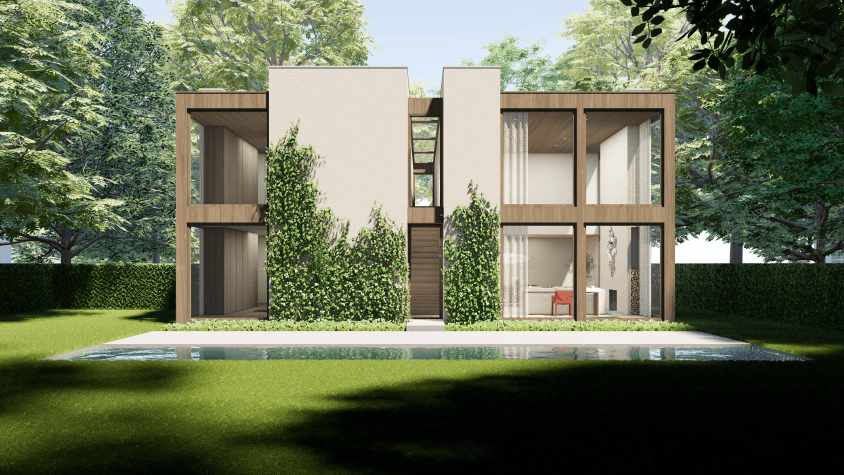
You worked on a suburban concept house for a developer a few years back. It was put on hold indefinitely, but it was still a positive experience, yes?
Yes, this was a fun project and hopefully it will be built one day. The site was in Westchester, close to where I moved recently, so in a way I was viewing it through my own experience of the area and what I would want in my own home.
What are you working on now?
Right now, I’m working on a townhouse addition in Brooklyn and a house in Colorado.
Are there any major differences between designing something in New York versus out west? Or any challenges?
There is a challenge that comes with having to manage a project in Colorado all the way from New York. This requires us to collaborate with a local architect who assists with the permitting process and acts as our eyes on the project, which takes an extra layer of coordination. Still, it’s interesting to work in a different place. Clients’ needs differ slightly. Because skiing is such a big part of life in Colorado, this house, of course, needs a room dedicated solely to skis and ski gear and other rooms dedicated to visitors.
What is a dream project for you?
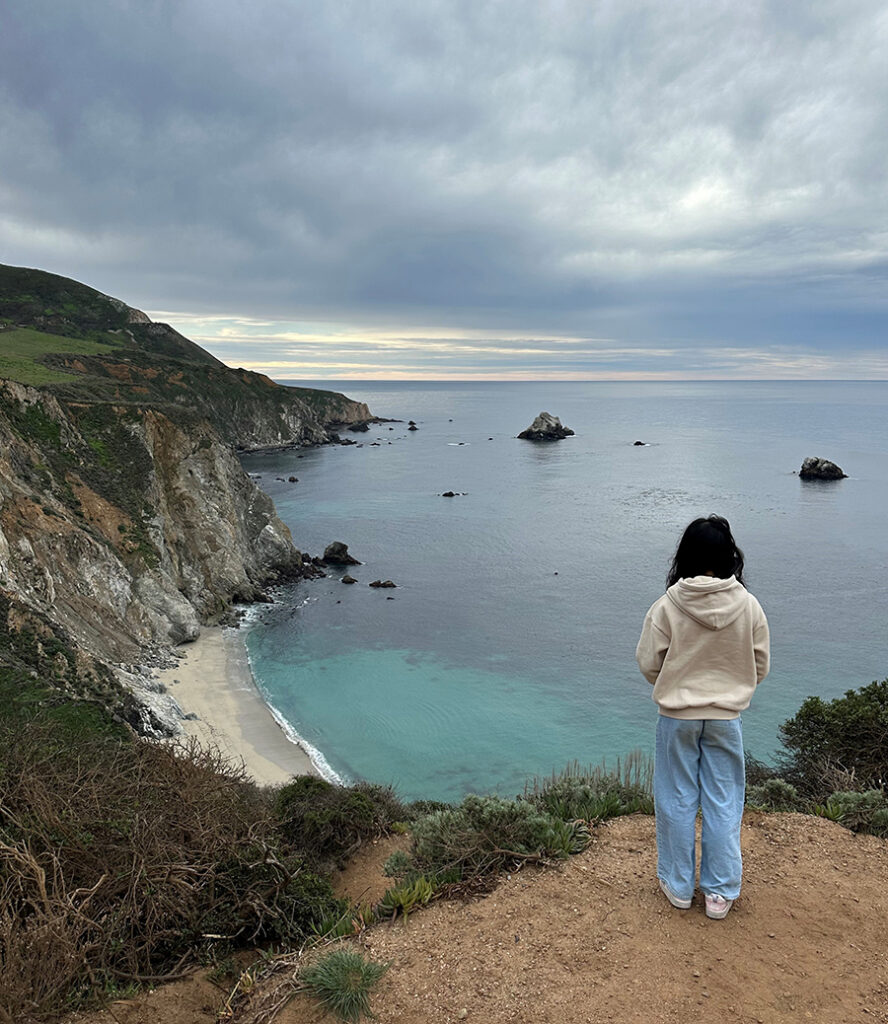
I would love to work on a house that is integrated in its surrounding landscape with a dramatic view, embedded in a cliff on Northern California coast or New York Hudson valley.
Oh right. I remember from last year’s post on our design influences you named an architect who is known for this. And you included an image of a spa, I think, built into the side of a mountain.
Yes. Peter Zumthor. Therme Vals.
Lastly, you’ve been at MR for 18 years. That’s a long time! What’s made you stay?
I’ve been at MR for a long time because the work has remained engaging and rewarding. Time really flies when you’re enjoying the projects, and one of the things I appreciate most is the diversity of the work. Every project brings a different set of challenges, clients, and design opportunities. There’s also an almost addictive quality to architecture; once you start a project, you become invested in seeing how it develops and ultimately turns out, and since projects can take years to complete, that naturally builds long-term commitment. Just as important, I’ve had the opportunity to work with very talented people, which has made the experience both collaborative and inspiring.