Whenever architects have the opportunity to design a ground-up home, they begin with a blank slate. When it comes to materials, their design includes a specification for every surface that will exist in the space—both interior and exterior—usually covering thousands of square feet. This aspect of a project is nothing short of monumental. The upside, however, is that the options are countless: glass, wood, stone, tile, handmade, machine-made, cool and modern, warm and natural…The list goes on. Specified materials can impact a project in numerous ways. They can direct the aesthetic of a design, or they can quietly serve as backdrops for decorative furnishings and accessories. They can be representative of a client’s background or interests, and they can shape a narrative about how the house is supposed to feel or be. For MR’s 2006 Carnegie Hill Townhouse, one of the firm’s earliest ground-up homes, senior associate and lead architect on the project, Scot Campbell, played a major part in the specification of the materials, whether that meant coming up with creative uses for woods or stones that MR was familiar with, or guiding the client on which materials best told his story. I asked Scot about the ins and outs of this project, specifically with regard to materials. Here’s what he had to say.
What did the client present you with in terms of what he wanted for his home? What was your starting point?
The client expressed an interest in “minimalism but with warmth”, meaning the number of different materials should be minimized and the feeling of warmth was critical versus a more typical “cold” minimalism. That said, he wanted stainless steel appliances and soapstone counters for the kitchen (as in professional kitchens), standard Dal tile for the secondary bathrooms and Corian for the laundry room. These preferences were driven by his focus on practicality for high-use areas. He also wanted white walls for a neutral backdrop for art which played an important role in the project.
When presented with this, what came to mind (in terms of materials) as to how you would achieve this?
There are many ways to achieve “warmth.” Natural materials (versus man-made) first came to mind, with both wood and stone as obvious starting points.
What happened next? What was your process for settling on the materials palette? Did you get it right the first time, or were there several rounds of presenting to the client?
Since we were designing a ground-up townhouse which involved a complete range of materials from exterior to interior, the selection process took many months. As we do with all projects, we started with a presentation of inspirational imagery, which is a way to get a conversation with the client moving, to reach deeper towards what they are really after. This practice helps foster a design relationship in order to tailor the look and feel of the project. In this case, we focused on the exterior and interior together, in order to relate the materials at different areas, and it did take several rounds to “get it right,” meaning that both MR and the client felt the selections were both exciting and appropriate.
Were there any materials that you had never used before? Any rare materials?
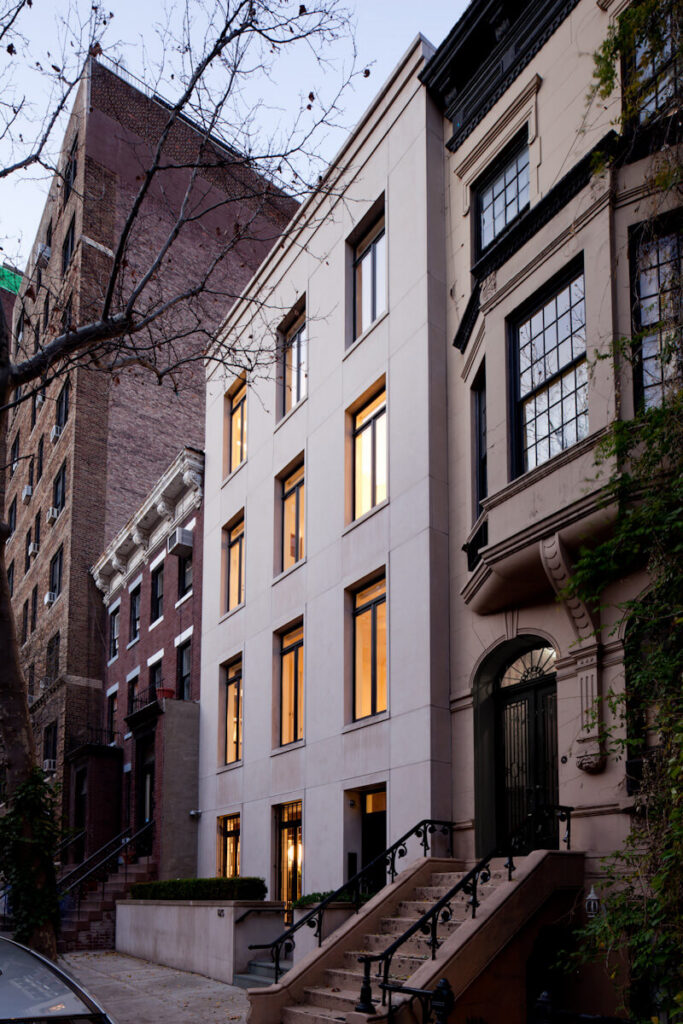
Indiana Limestone was selected for the front façade. It’s a material we hadn’t previously worked with but has been used for centuries all over the world for notable structures. It was a perfect fit for several reasons. Because the block that this property is located on is landmarked, the townhouse’s front façade design required Landmarks approval. While limestone is more common on buildings closer to Central Park, it has a significant presence in New York City architecture and therefore was considered historically appropriate. Next, because the client was originally from Indiana (where the stone was quarried) there was a personal connection. There were not really any rare materials used. We focused on more classic materials for this project.
Were there any materials that you and the client loved, but had to be eliminated due to cost?
We didn’t eliminate any materials due to cost, but we did limit locations of materials for cost reasons. For example, the Indiana limestone was originally specified for the rear façade and garden walls, but we value-engineered those areas to a complimentary color stucco instead.
Was there any material the client really liked or wanted that you did not think was a wise choice? If so, how to did you handle this?
Not really. The client wasn’t pushing personal favorites and felt that MR should drive the initial selections for him to react to. While we encourage collaboration with our clients, we also always appreciate when they entrust us to guide these processes.
On that note—do you prefer using materials you are well-acquainted with or do you like to source new things?
Both really, and there are pros and cons. We’re always striving to innovate, and that can involve sourcing new things and developing details that we haven’t executed previously. We feel that is essential for each project. However, we need to balance that approach with practicality and a level of comfort that comes with specifying materials we’ve used before and are well-acquainted with.
Were there any issues with any materials that you did not expect. How did you resolve them?
We specified soapstone kitchen countertops for both their beauty and durability (the client was an avid home chef), knowing they would need maintenance over time which involved oiling/sealing. What we didn’t realize was that the stone would gradually lighten in color between maintenance cycles. The stone would transition in tone from a deep black to a dark gray, then back to a deep black when oiled. We resolved this by decreasing the time between maintenance cycles, and eventually, the stone began to stay as deep black.
Was there any material that you (or the client) was disappointed in and will never use again?
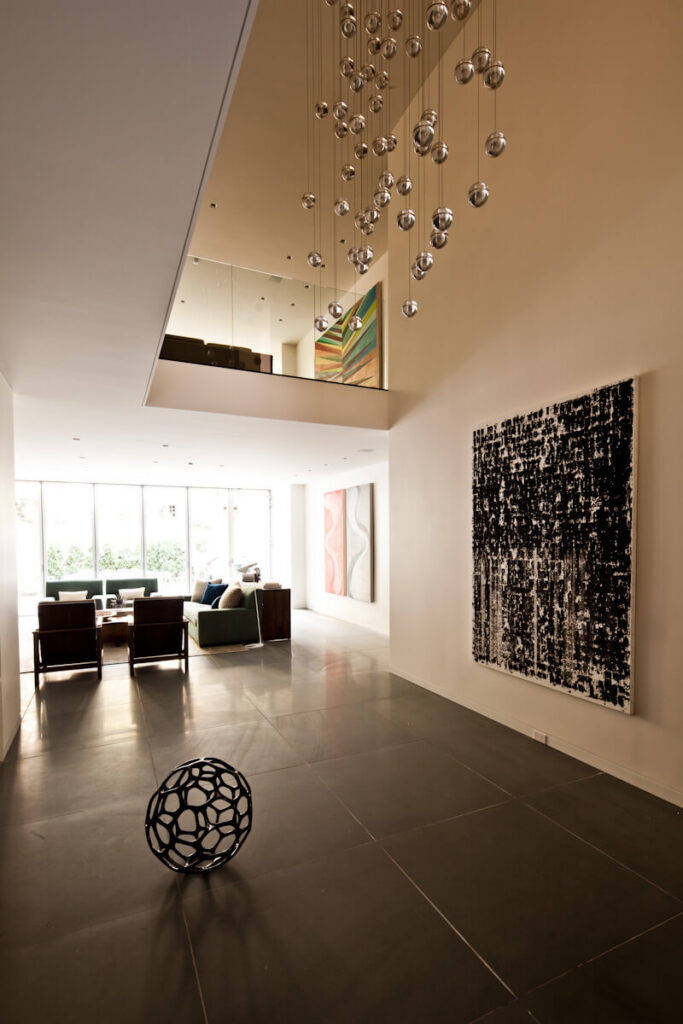
I wouldn’t go so far as never using it again, but we specified bluestone for the ground floor at both the interior and exterior which came with some challenges. We selected bluestone because it is one of the most common materials used for residential stoops. Following the minimalist direction of the project, we created a seamless transition from the front entrance into the interior and then out to the back patio. After some time, the exterior bluestone weathered to a slightly lighter color, and the interior bluestone (that received high traffic and needed regular maintenance) actually turned a darker color from the sealant that was used. In the end, the issues were resolved, but after the experience, we know to keep in mind the maintenance issues that come with using this material.
Was there any material you used for the first time that has since become a go-to material?
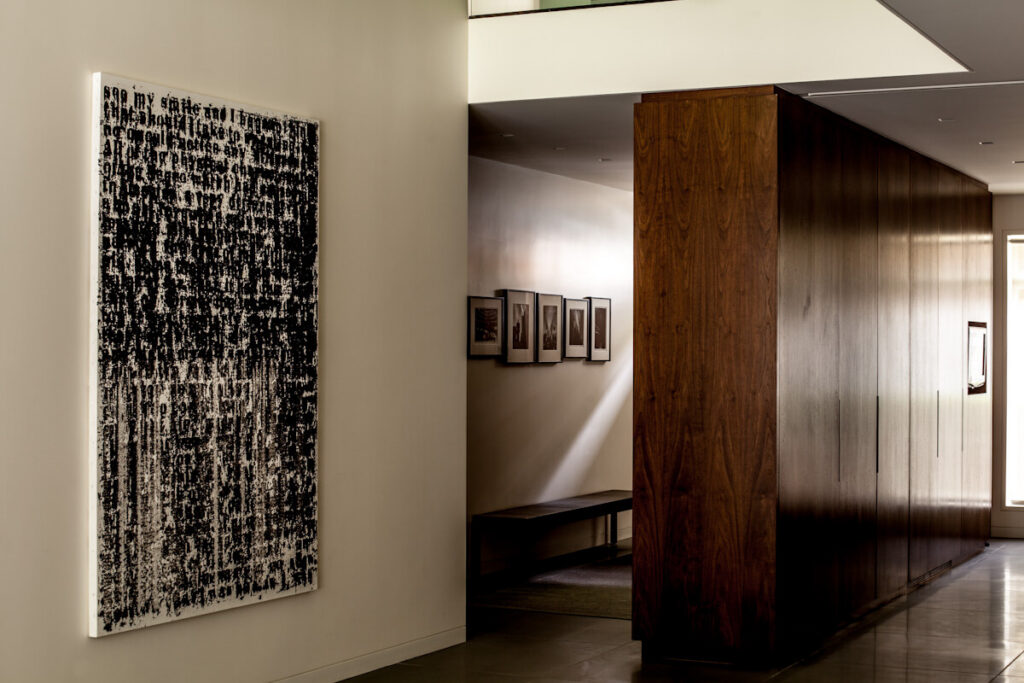
At the time, it was a first for plain sawn walnut veneer millwork, which we’ve specified many times since. It has a gorgeous grain that varies based on the type of cut, from a more uniform straight-grain quarter-sawn versus a more varied plain-sawn which has more movement. It’s also a versatile material with many variations based on how it takes stain, bleaching or whitewashing.
MR did both the architecture and decor. In a project like this, when in the timeline does the decor phase start? How does that process happen? What do you do to be sure that the decor works with the architecture so that overall, the project is cohesive?
For ground-up projects like this, we design from both outside-in and inside-out. It’s really a design-phase back-and-forth between the building (architecture) informing the furniture and furnishings (decor), and vice versa for many iterations. Creating a structure with a cohesive form and symmetry on the exterior that also incorporates logical room locations and proportions on the interior is one goal. Making sure that the architectural aspects of the interiors (proportions, layouts and materials palettes) are in symmetry with the elements of decor (window treatments, carpets and rugs, furniture and accessories) is another goal. We achieved both here by designing furniture layouts for all interior spaces at the same time as we were designing the core and shell structure, overseeing progress on both simultaneously, which allowed us to make adjustments as needed.
This project was from several years ago and the client no longer lives there. Based on materials that were used in the initial design, do you imagine a new buyer would want it renovated for the sake of updating it, or do you feel the materials used were timeless?
We were lucky enough to be contacted by the new buyer who was interested in the history of the project. They were a young family who said they loved the townhome as-is and weren’t interested in any major changes. It’s a high bar for a design and the specified materials to be truly timeless but given that we started designing the project in 2003, that’s pretty good!
Anything else interesting with regard to materials used in the project?
I’d say our use of walnut. With the exception of freestanding furniture, it was the only wood used (as mentioned earlier), as veneer for millwork in the kitchen and for closets on the upper levels, in solid wood for the staircase, the stair handrails and for flooring in all but a few of the public areas and in all of the bedrooms. It was interesting because the tone of the walnut in each application, while the same wood species, was slightly different—lighter in same places darker in others. Still, it all worked really beautifully together. Another interesting use of material was the Bluestone that we specified all the way from the front entrance stoop, throughout the ground floor interior and out to the rear patio. We Blackened steel was another material we used on both the exterior (window guards) and the interior (the wine room shelving.) This material is an MR favorite and it’s always interesting to see it applied in a residential space.
Are there any materials you’re really excited about that you haven’t used before and hope to on future projects? Or any new or interesting ways of using ones you are very familiar with?
Personally, I find it interesting to use well-known materials in a unique way. I think it would be exciting to explore customized uses for cast-in-place concrete but in a refined or calm way.